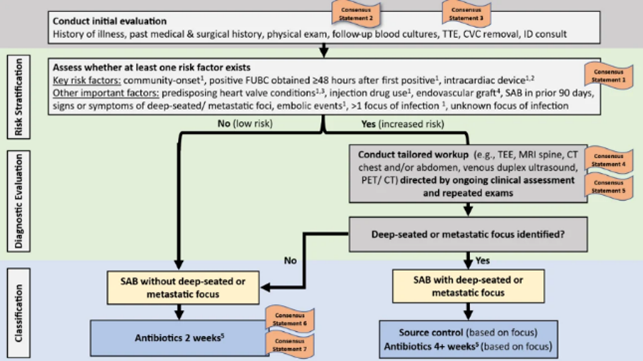
S.aureus bacteremia (SAB) is a serious, heterogeneous bloodstream infection associated with high mortality and potentially occult deep-seated or metastatic complications. The proposed framework replaces the traditional “complicated/uncomplicated” classification with dynamic risk stratification, using follow-up blood cultures, echocardiography, clinical reassessment, and tailored imaging to identify infection foci and guide source control. A 14-day treatment course may be appropriate for patients without identified deep-seated or metastatic infection, including selected higher-risk cases, while longer therapy should be considered when such infection cannot be confidently excluded.

AMR news
Septembrer- October 2026

Fighting antimicrobial resistance through better patient care: ordering the right test from the right patient to determine the right treatment Japan and WHO support Western Pacific countries to strengthen clinical diagnostic stewardship and antimicrobial stewardship.
World Health Organization (WHO), 16 September 2026.
The World Health Organization and the Government of Japan convened a three-day workshop in Tokyo with health officials from seven Western Pacific countries to share experiences in fighting antimicrobial resistance (AMR). The participants focused on enhancing clinical diagnostic and antimicrobial stewardship as vital public health strategies to mitigate the global threat of AMR. This text explains that AMR, driven by the overuse of antibiotics, is projected to cause over 5 million deaths in the Western Pacific Region between 2020 and 2030. In response, the WHO has published a practical manual to guide health facilities in combining clinical diagnostic and antimicrobial stewardship to ensure accurate testing and targeted treatments.
Antimicrobial resistance: Americas adopt new regional action plan. Pan American Health Organization-
World Health Organization (WHO), 16 September 2026.
Health leaders at the 63rd Directing Council of the Pan American Health Organization (PAHO) have adopted a new regional Plan of Action on Antimicrobial Resistance (AMR) 2027–2031 to prevent, detect, and respond to drug-resistant infections. Built upon a One Health approach, the plan establishes six strategic lines of action that emphasize behavioral change, enhanced surveillance, infection prevention, and sustainable multisectoral governance across the Americas. While 30 of the 33 reporting Member States have already introduced national action plans, this framework aims to bridge remaining regional gaps in laboratory capacity, sustainable financing, and access to quality-assured medicines.
Antimicrobial IDSA/ESCMID 2026 Consensus Statements on Staphylococcus aureus Bacteremia: Risk Stratification, Diagnostic Evaluation, and Management of Adults and Children
Published September 09, 2026
Use of standard definitions for the extent of antibiotic resistance in bacteria: a systematic review and framework for future consensus definitions
Tan WC, et al. JAC Antimicrob Resist. 2026 Sep 15;8(5):dlag205
Standardized definitions of drug-resistant bacteria are essential for clear research communication and effective health policies. A review of 2,465 studies found that multidrug resistance (MDR) was the most commonly used term, although 38% of articles did not provide a definition. Updated definitions should include new antibiotics and genetic resistance markers, while considering drug effectiveness, toxicity, availability, and patient outcomes.
Modern Challenges of Antimicrobial Resistance and Innovative Approaches to the Treatment of Bacterial Infections.
Klyachko, N.L. et al - Russian Journal of Bioorganic Chemistry, 52, 130; published 04 September 2026.
The global rise of antimicrobial resistance severely threatens public health by diminishing the effectiveness of traditional treatments and increasing adverse effects. This review highlights the molecular mechanisms of bacterial resistance and explores both established and innovative antibacterial therapies to address multidrug-resistant infections.
Carbapenem-Resistant Enterobacterales (CRE) in Europe: Surveillance Challenges, Emerging Threats and Public Health Preparedness
Kuszewska K. et al - Antibiotics, 15(8), 790; Published: 15 August 2026.
A narrative review highlights carbapenem-resistant Enterobacterales (CRE) as a major and evolving AMR threat in Europe, driven particularly by carbapenem-resistant K. pneumoniae, high-risk clones and mobile resistance elements. Despite established European surveillance networks, substantial differences remain across countries in diagnostic and genomic capacity, reporting, infection prevention and control, and antimicrobial stewardship. The authors call for integrated microbiological, genomic, epidemiological and antimicrobial-consumption surveillance within a One Health framework, alongside harmonized indicators and strengthened healthcare preparedness to improve detection and control of CRE across Europe.
Acquired carbapenemase-producing organisms in North London: health inequalities and healthcare associations, 2016–2023.
Chattaway MA, et al. JAC Antimicrob Resist. 2026 Sep 11;8(5):dlag200.
Carbapenemase-producing organisms represent a major public health challenge and emerge through both healthcare- and community-associated pathways. Among 651 patients at a London teaching hospital, OXA-48-like and NDM were the predominant carbapenemases, with higher positivity linked to certain medical specialties, male sex, age, ethnicity, and intermediate levels of deprivation. Classifying cases as hospital-onset, community-onset healthcare-associated, or community-associated can improve local epidemiological understanding and support targeted infection-prevention strategies.
The Transmission of Multidrug-Resistant Bacteria and Antibiotic Resistance Genes from the One Health Perspective
Chai K, et al - Antibiotics 2026, 15(10), 980; Published: 4 October 2026
This review examines antimicrobial resistance (AMR) as a complex One Health issue by analyzing the transmission of multidrug-resistant bacteria and resistance genes across humans, animals, and the environment. By establishing a unified cross-disciplinary framework, the One Health approach maps complete transmission chains and serves as an indispensable guiding principle for addressing global health challenges.
Genetic and Non-Genetic Mechanisms of Antibiotic Resistance and Their Implications for Global Surveillance
Safdar A, et a. SN Comprehensive Clinical Medicine (2026) 8:450.
Antimicrobial resistance is a critical global health issue driven not only by heritable genetic mutations but also by a second class of transient mechanisms like tolerance, persistence, and hetero-resistance. This review examines these alternative phenomena, including biofilm-associated tolerance and gene amplification, which affect only fractions of a bacterial population and disappear once antibiotic selection is removed. Because current diagnostic and surveillance systems rely on population averages or sequencing, they remain completely blind to these non-heritable, phenotypic variations.